

Today, Impact Florida is introducing the Florida Materials Navigator, a free statewide digital resource created to help Florida school districts plan for, select, adopt, and implement high-quality instructional materials.
You can explore it now at flmaterialsnavigator.org.

Having led curriculum and instructional materials work in a Florida district, I know how much responsibility sits with the teams guiding an adoption process. District leaders must bring together people with different roles and perspectives. They must manage timelines, budgets, state and local requirements, committee processes, community input, purchasing decisions, and plans to support teachers.
At the same time, they’re making decisions that will shape classroom instruction for years.
District teams shouldn’t have to piece that process together on their own.
Built to Support the Work Districts Are Already Leading
The Florida Materials Navigator gives district teams a clear, organized way to move through instructional materials decisions without starting from scratch.
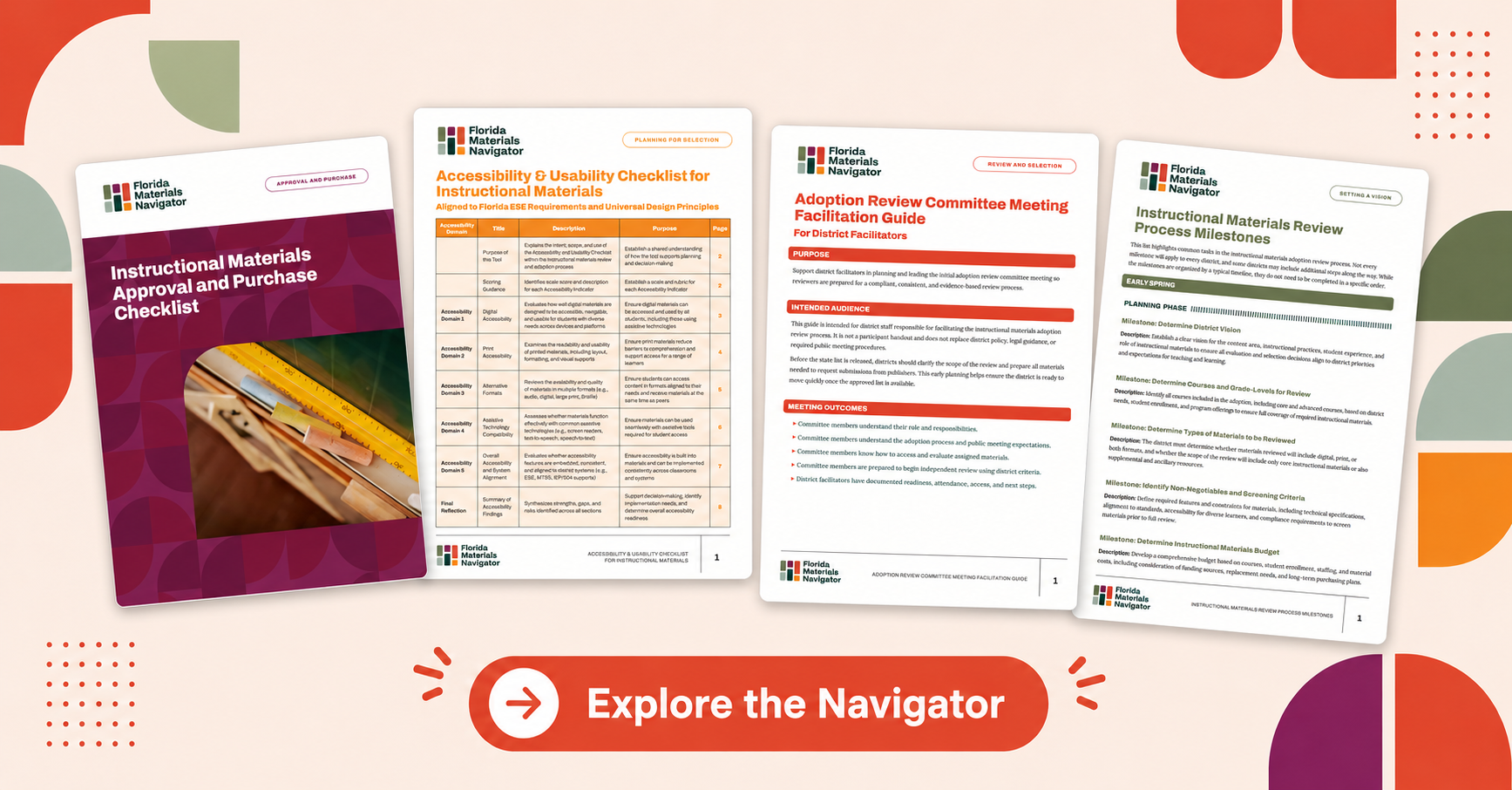
It brings practical tools, templates, guidance, and examples together in one place. We've organized resources around the decisions districts already need to make, from setting an instructional vision and preparing a review committee to evaluating options and supporting teachers once new materials reach classrooms.
The Navigator does not change Florida’s instructional materials adoption process. It does not replace the state-adopted list, district policies, or existing requirements. It also does not tell districts which materials to choose or endorse particular publishers.
Instead, the Navigator helps district teams build a clear process that reflects their instructional goals, student needs, teacher supports, local context, and capacity for implementation.
A Connected Path From Preparation to Classroom Use
Instructional materials decisions do not happen in one meeting or follow a perfectly straight path. District teams often move between planning, review, stakeholder engagement, purchasing, training, and classroom support.
The Navigator organizes that work into three connected phases: Prepare, Adopt, and Implement.
Prepare
Strong materials decisions begin before a team reviews its first program. In the Prepare phase, districts can find resources to help them:
- Define a shared instructional vision
- Clarify what high-quality instruction should look like in local classrooms
- Establish clear selection criteria and priorities
- Plan the review process and timeline
- Build and prepare a review committee
- Engage educators, families, and other stakeholders
This early work helps teams focus on the student and classroom experience they want to create, rather than reacting to program features or presentations.
Adopt
During the Adopt phase, district teams move from priorities and criteria to a local decision. The Navigator includes support for:
- Initially sorting and comparing options from the state-adopted list
- Conducting a more detailed evaluation
- Applying district criteria consistently
- Facilitating review committee meetings
- Gathering and using stakeholder input
- Managing timelines and publisher requests
- Attending to approval, purchasing, and existing compliance requirements
The goal in this phase is to help districts use a clear, consistent process and document how its final recommendation reflects local priorities.
Implement
Selecting materials is an important milestone, but it is not the end of the work. The Implement phase helps districts prepare for what happens after a selection is made. Resources support teams as they:
- Plan the rollout
- Prepare teachers to use the materials
- Coordinate professional learning and school-based support
- Establish clear expectations for classroom use
- Identify challenges early
- Gather feedback and strengthen implementation over time
Instructional materials can only support strong teaching and student learning when educators have the preparation, clarity, and ongoing support to use them well.
Built Alongside Florida Districts
The Navigator grew from Impact Florida’s work with district leaders across the state.
Through years of direct partnership, we have heard the questions district teams ask, seen the obstacles that can slow the process, and observed the types of support that help leaders move forward. That experience shaped both the Navigator’s structure and its resources.
The Navigator is designed for instructional materials administrators, curriculum specialists, subject-area leaders, chief academic officers, assistant superintendents, educators serving on review committees, and others who help lead adoption and implementation.
Districts can use the resources as written or adapt them to fit local roles, timelines, priorities, and procedures. Teams with an established process can use the Navigator to identify gaps in their process or strengthen specific parts of their work. Districts that are building a process can use it as a starting point.
District teams can enter the Navigator from wherever they are in the materials adoption process and find support for the decision in front of them.
Supporting the Upcoming Math Adoption and the Work Ahead
The Navigator arrives as Florida districts prepare for the upcoming mathematics instructional materials adoption. We know many district teams are already thinking about their instructional vision, committee structure, local criteria, evaluation process, and implementation needs.
The Navigator can support those immediate decisions.
It is also being built for the long term. We hope the Navigator becomes a resource districts return to across subjects and adoption cycles as they plan, select, implement, and refine their approach.
We will continue to update the Navigator based on district needs, user feedback, lessons from implementation, and changes across future adoption cycles.
Start Where You Are
Visit the Navigator and choose the phase that best matches your district’s current work. You can explore the full pathway or go directly to the resource library to find tools for an upcoming meeting or decision.
Bookmark the site and share it with the colleagues who lead or support instructional materials work in your district. Then return as your team moves from preparation to adoption and from selection to classroom implementation.
I look forward to hearing how your district uses the Navigator.